
Threat scans show many websites are left exposed through basic oversights
Key takeaways
- The average web application features 20 security vulnerabilities.
- Information disclosure and brand impersonation vulnerabilities account for 49% of detected flaws — they can help attackers map targets and deceive users.
- Most web application risk stems from common security oversights rather than sophisticated attacks, highlighting the importance of continuous monitoring, patching and security hygiene.
The number of security vulnerabilities per web application
Barracuda’s Application Security Insight data reveals that the average web application contains 20 security vulnerabilities that could be exploited by attackers to steal data, compromise accounts or gain unauthorized access to systems.
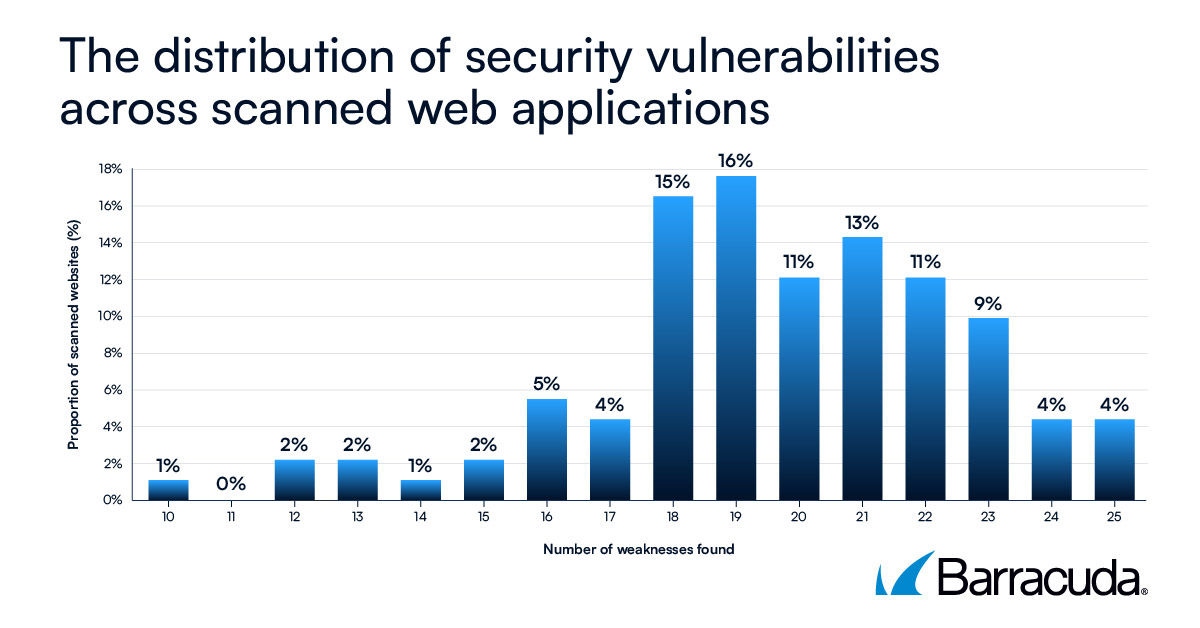
These security vulnerabilities can be grouped into types. This article highlights the seven key types of vulnerability detected over five months in 2026, how attackers can exploit them, and the action security admins can take to strengthen protection and mitigate risk. These seven categories represent approximately 90% of all vulnerabilities detected.
Vulnerability type: Reconnaissance and information disclosure
The security flaw: The application or its infrastructure reveals too much information about its systems, domains, hidden pages, routes, or services.
One in four (25%) of the security vulnerabilities detected in customer environments by Barracuda’s Application Security Insight falls into this category.
How attackers can exploit this: Attackers can use this to map the target’s environment, identify weak points, discover hidden endpoints, find hidden admin areas, and plan more targeted attacks — all while remaining undetected.
How to reduce risk:
- Remove unnecessary and exposed metadata.
- Disable directory listings.
- Restrict access to sensitive or internal endpoints.
- Remove debug information.
- Monitor scanning behavior.
- Limit unnecessary DNS or infrastructure exposure.
Vulnerability type: Brand impersonation and spoofing
The security flaw: Weaknesses that make it easier for attackers to impersonate a trusted brand, website or domain and deceive users into sharing credentials or sensitive information.
Brand impersonation and spoofing accounts for 24% of the security flaws detected.
How attackers can exploit this: Attackers can use compromised identities to clone web pages, redirect users to malicious sites, steal logins, or send believable phishing emails using the brand.
How to reduce risk:
- Enforce industry authentication standards to prevent domain spoofing, such as DMARC (Domain-based Message Authentication, Reporting and Conformance), SPF and DKIM.
- Use HTTPS with strict certificate validation.
- Deploy email security that offers anti-phishing protection such as browser isolation and link scanning.
Vulnerability type: Client-side attacks (browser exploitation)
The security flaw: Weaknesses in how web pages display or execute content, allowing attackers to run malicious scripts in a user’s browser.
Client-side attack exposure accounts for 14% of the security flaws detected.
How attackers can exploit this: Attackers may inject scripts (cross-site scripting (XSS)), for example to steal session cookies, alter visible content, trick users into clicking hidden buttons, or upload misleading files (file type confusion).
How to reduce risk:
- Validate and encode all input such as user-entered data before processing.
- Ensure that user-supplied content is treated as text rather than executable code.
- Validate files to ensure they are the type (MIME type) they claim to be.
- Validate and sanitize all inputs.
- Add anti-clickjacking headers such as CSP (Content Security Policy) and X-Frame-Options, which block malicious scripts, restrict which websites can load images, fonts and other content, and prevent web pages from being embedded on another website.
Vulnerability type: Data exposure and privacy risks
The security flaw: Sensitive information is exposed unnecessarily through the application, for example through web pages, APIs, logs, cookies, tracking scripts, or misconfigured responses.
Data exposure and privacy risks account for 10% of detected security flaws.
How attackers can exploit this: Collect personal data, tokens, private content, secrets, or confidential business information, including emails and configuration settings; track users without their consent; and tamper with access controls and data retention policies.
How to reduce risk:
- Minimize the volume and nature of exposed data.
- Encrypt sensitive information, review logs and API responses.
- Encrypt sensitive data in transit and at rest.
- Review APIs and logs for leaks.
- Apply data classification and access controls.
Vulnerability type: Network and transport security issues
The security flaw: Weak or missing encryption allows attackers to intercept or manipulate traffic.
Network and transport security issues account for 6% of detected security flaws.
How attackers can exploit this: Intercept credentials, steal session tokens or alter traffic in transit, for example through adversary-in-the-middle (AiTM) attacks and DNS manipulation.
How to reduce risk:
- Enforce HTTPS everywhere.
- Enable HSTS (HTTP Strict Transport Security) to ensure browsers always use HTTPS when connecting to your site.
- Remove mixed content (for example an image delivered over HTTP).
- Secure network traffic by using modern TLS (Transport Layer Security), secure certificates and DNSSEC (Domain Name System Security Extensions) where appropriate to add cryptographic protection to DNS records.
Vulnerability type: Configuration and patch management issues
The security flaw: Outdated software or insecure configurations make attacks easier.
Configuration and patch management issues account for 6% of detected security flaws.
How attackers can exploit this: Attackers can use readily available public exploit code, automated scanners or known techniques against unpatched systems.
How to reduce risk:
- Establish and maintain a committed approach to patching.
- Run continuous vulnerability scanning.
- Harden configurations.
- Remove obsolete software.
- Track known exploited vulnerabilities.
Vulnerability type: Session and authentication weaknesses
The security flaw: Weaknesses in how user sessions are managed and how cookies and credentials are protected, making it easier for attackers to take over accounts.
Session and authentication weaknesses account for 5% of detected security flaws.
How attackers can exploit this: Attackers may steal session cookies, maintain persistent access to user accounts or bypass authentication controls
How to reduce risk:
- Use secure, HttpOnly or SameSite cookie flags.
- Shorten session lifetimes.
- Rotate tokens.
- Enforce re-authentication for sensitive actions.
- Implement and consistently enforce multifactor authentication (MFA).
Conclusion
The findings show that everyday configuration mistakes, brand impersonation and information disclosure issues remain widespread.
An average of 20 security flaws per web application means attackers have multiple opportunities to probe, test and exploit weaknesses. While not every flaw is critical on its own, several low- and medium-risk vulnerabilities can be combined to reveal sensitive information, steal credentials or gain unauthorized access to systems.
How Barracuda can help
Barracuda Application Protection offers a comprehensive set of integrated capabilities, including advanced Web Application and API Protection (WAAP), to ensure complete application security.






Iscriviti al blog di Barracuda.
Iscriviti per ricevere i Threat Spotlight, commenti del settore e altro ancora.