
Why layered protection matters for Google Workspace
Why native protections alone can’t keep up with modern email threats in Google Workspace
Takeaways
- Email is no longer just communication—it’s a gateway to cloud apps, data, financial workflows, and identities.
- Native email security can’t see enough context on its own. Layered email security assumes something will get through—and plans for it.
- Effective protection combines detection before and after delivery with automation and context to reduce response time, limit user exposure and lower overall risk.
Google Workspace has become the communication backbone for millions of organizations. Email, documents, chat, and collaboration live in one place. That helps teams move faster and work from anywhere. And to their credit, Google Workspace includes solid native security capabilities that block large volumes of spam, phishing and known malware every day.
But the nature of email threats is changing faster than native protections can keep up.
Modern attacks are no longer obvious. They’re targeted to exploit human trust rather than technical flaws. Attackers don’t always need to overwhelm inboxes with junk when a single well‑crafted message can lead to stolen credentials and account takeover. In an environment where 3.4 billion malicious emails are sent globally every day, even a small percentage slipping through can have serious consequences.
When email becomes the front door to your business
With Google Workspace, email is deeply intertwined with identity and business workflows, which has expanded both the attack surface and the potential impact of successful phishing or impersonation attempts.
Research shows a 127% year‑over‑year increase in identity‑based attacks targeting Google Workspace, as threat actors move beyond broad phishing campaigns to targeted techniques that abuse compromised accounts and trusted relationships.
Business email compromise (BEC) is a prime example. Sixty‑three percent of organizations experienced at least one BEC attempt in the past year, with attackers impersonating executives, vendors, or partners to redirect payments or extract sensitive information. These emails are specifically designed to look routine, timely, and authentic.
Account takeover follows a similar pattern. Stolen credentials are one of the most common initial access vectors in breaches. Once an attacker gains access, they’re no longer operating outside the environment; they’re operating from within it.
Where native protections begin to show their limits
Native security is primarily optimized to stop known threats at scale, not necessarily to fully understand context, intent or evolving attacker behavior.
Google Workspace uses authentication as a foundational control, but it must be layered with additional protections to address attacks that originate from seemingly trusted or authenticated sources. This includes compromised accounts and lookalike identities.
Additionally, in Google Workspace, email security coverage varies based on configuration and license tier. Certain advanced phishing, malware and investigation capabilities are only available in higher tier editions or must be explicitly enabled by administrators, which can create visibility and response gaps that are difficult for security teams to consistently identify and manage.
In many environments, post‑delivery investigation and remediation remain manual processes. Security teams rely on time-consuming user‑reported messages, log searches and hands-on cleanup—and that delay matters. The lack of automation is a major obstacle to faster incident response, leaving malicious messages active in inboxes longer than they should be, and increasing the likelihood of user interaction.
What Barracuda Email Protection adds for Google Workspace
Barracuda Email Protection works alongside Google Workspace to strengthen native email security without disrupting users or changing mail flow. Rather than replacing Google’s baseline protections, Barracuda extends them by adding deeper insight into intent, behavior and activity that unfolds both before and after an email reaches the inbox which reflects how modern attacks operate.
Using an application programming interface (API)-based integration, Barracuda deploys seamlessly without mail exchange (MX) record changes and applies consistent protection across all users, regardless of Google Workspace edition or configuration. This helps eliminate coverage gaps that can arise from licensing differences or manual setup.
Barracuda analyzes emails using behavioral and relationship context— including sender behavior over time, historical communication patterns, writing style, impersonation signals, and domain similarity— to detect social engineering attacks that pass authentication and reputation checks. This enables Barracuda to identify threats like fraud, vendor impersonation and conversation hijacking when messages appear routine and technically valid.
Protection continues after delivery. Barracuda monitors mailboxes for threats that bypass initial controls or emerge later, such as compromised accounts, malicious replies or delayed payload attacks. When a threat is confirmed, Barracuda automatically removes malicious emails from affected inboxes, reducing dwell time, limiting user exposure, and eliminating manual cleanup. For lean security teams, this automation accelerates response and helps contain attacks before trust is abused or damage spreads.
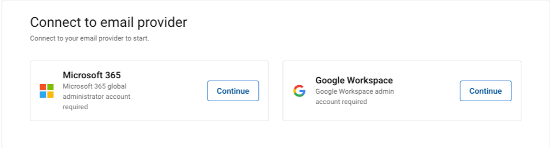
Barracuda Email Protection – Google Workspace
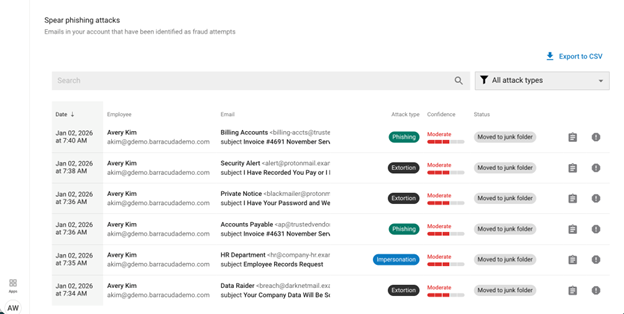
Barracuda Email Protection – Spear phishing attacks
Security that matches how email attacks actually work
Email remains the most exploited attack vector because it continues to work. As identity becomes the new perimeter, attackers increasingly rely on trust and legitimate‑looking access rather than obvious technical exploits. Defending against these threats requires email security that aligns with how modern attacks unfold.
For small security teams, the challenge isn’t only what gets through, but how quickly threats can be identified and removed once they reach the inbox. Layered email protection reduces this burden by adding intent‑based detection and automating post‑delivery response, enabling faster containment and reduced user exposure - making layered security a practical requirement.
Learn how layered email protection strengthens Google Workspace security
Join our upcoming webinar to see how modern email attacks bypass native controls and how layered email protection helps detect, investigate, and remediate threats before trust is exploited. You’ll learn practical strategies for reducing response time, limiting user exposure, and closing visibility gaps in Google Workspace environments.






Iscriviti al blog di Barracuda.
Iscriviti per ricevere i Threat Spotlight, commenti del settore e altro ancora.